Tuesday, October 2, 2012

As We Close This Conference

This entry is part of my general conference application series.

As We Close This Conference, by Thomas S. Monson
President, Church of Jesus Christ of Latter-day Saints


Some believe that politics and religion don't mix. Apparently I'm not one that does. If I haven't scared you away, here are my concluding thoughts on this conference:

Are you better off than you were four years ago?

I hear this question thrown around in the current political contest and have a hard time answering. I think the reason is because I feel like a different person than I was four years ago. Let me explain:

Four years ago:
  • I had two children—half as many children as I do now (okay, exactly four years ago my third was two months old, but you know what I mean)
  • I was near the beginning of what seemed an insurmountable graduate school experience
  • I was a dirt-poor student (see previous)
  • I was madly in love with my wife

Four years later (now):
  • I have four [active] children
  • I've graduated and am at the beginning of what seems like an insurmountable mortgage
  • I live like I'm dirt-poor (is debt-poor a valid substitute)
  • I'm madly in love with my wife

Okay, some of the things are similar or the same—it's not fair that I'm fatter and balder than I was then, but my wife looks as radiant, if not more so, than she did then!—but I had another question come to mind as I reviewed President Monson's final talk days before the next general conference:

Am I better off than I was six months ago? (spiritually)

I write these general conference application series posts—and have a good time doing so—but am I improved at all?

I hope so.

These words of a living prophet reassure me that I am better:


I think you will agree with me that we have felt the Spirit of the Lord as our hearts have been touched and our testimonies strengthened. . .

How blessed we are, my brothers and sisters, to have the restored gospel of Jesus Christ in our lives and in our hearts. It provides answers to life’s greatest questions. It provides meaning and purpose and hope to our lives. . .

May your homes be filled with love and courtesy and with the Spirit of the Lord. Love your families.


These words, delivered in love, remind me of the things I've learned and been reminded of in my review of these general conference addresses. After doing so, I want to be even better and love my family even more!

Even though I recognize that I still have many areas where I need to improve, my study and review of these talks has given me hope and encouragement for the future. It turns out, President Monson predicted this would happen:


May you ponder the truths you have heard, and may they help you to become even better than you were when conference began two days ago.


As I like to do, here is a word cloud of the conference proceedings, which is a repeat of when I reviewed President Monson's opening address (link). The word that stands out to me now is power:


What Thinks Christ of Me?

This entry is part of my general conference application series.

What Thinks Christ of Me?, by Neil L. Andersen
Of the Quorum of the Twelve Apostles


Do you remember the craze for WWJD bracelets in the late 90's? I do. I was serving as a full-time missionary at the time, and I loved that so many were showing a physical reminder to be Christlike with the simply question, "What would Jesus Do?" At the time, I would twist the question slightly to: What would Jesus have me do? (I mentioned this in an earlier post, link, but please keep reading this one.)

Those bracelets may have helped people remember Jesus while being a signal to others of a claim to Christianity—much like the fish symbol on the back of some cars. When I think of visible signals of faith, I wonder if I have any tells or signs of what I believe. This reminds me of a question I had long ago while riding my bike to work: "If I were put on trial for being Christian (or LDS), would there be enough evidence to convict me?" (read more of this experience here)

Interestingly, I often think of these visible signals of faith when I see someone driving dangerously or rudely who has one of those fish symbols on the back of their car. As I judge them and silently scream at them to try harder to be Christlike, I wonder what others think of me!

In his talk, Elder Andersen seemed to flip these questions on their heads:


Jesus asked the Pharisees, "What think ye of Christ?" In the final assessment, our personal discipleship will not be judged by friends or foes. Rather, as Paul said, "We shall all stand before the judgment seat of Christ." At that day the important question for each of us will be, "What thinks Christ of me?"


What thinks Christ of me?

I admit that I probably spend too much time wondering if others think I'm good enough, or if they can tell what I believe by my actions. I like this twist that Elder Andersen introduced because if I live so that I'm comfortable with who I am and what I do—all while imagining the Savior standing beside me (link)—then what other think either won't matter, or I'll be so comfortable with myself and my actions that others will see the light of Christ in me.

An additional thing I like about this change to the question is that it isn't affected by changing circumstances. I watched with a mix of concern and humor as Mitt Romney (a member of the Church) seemed lambasted by the far-right in their implied religious test during the primaries. They argued that he wasn't Christian and didn't qualify for their vote. However, after he was ultimately nominated (maybe by default against the ineptitude of his rivals?), the erstwhile critics' tune changed to, "Well, he's Christian enough."

I may or may not be a fan of Romney's politics, but I like to think that he tries to make decisions the same way I do: after reasoned weighing of options and expected outcomes, all while measuring against divine standards.

Let's get away from politics now.

After telling that President Monson often reminds General Authorities to remember the question, "What would Jesus do?", Elder Andersen taught:


Discipleship is believing Him in seasons of peace and believing Him in seasons of difficulty, when our pain and fear are calmed only by the conviction that He loves us and keeps His promises.


I'm still trying to work out what I think the answer to "What thinks Christ of me?" is. But as I try to remember Jesus, consider what He would have me do, and be a disciple in times of peace and difficulty, I'm confident that over time, I'll come to feel that Christ does trust me and can count on me to be who I really want to be.

And I won't even need to wear a bracelet!

Monday, October 1, 2012

To Hold Sacred

This entry is part of my general conference application series.

To Hold Sacred, by Paul B. Pieper
Of the Seventy



I've mentioned that my new assignment at church is to be the music leader in primary. I'm still learning how to help children spanning the ages of 18-months to 12-years-old, but this learning process is more comfortable than I thought it would be. A few things happened yesterday that I was reminded of as I reviewed Elder Pieper's talk:

1.
In junior primary (children aged 3-8), I led the opening song. After learning that the lesson for the day was on honoring parents, I chose to sing I Am a Child of God. Standing in front of a room full of children, I realized that their singing wasn't perfect: many were wiggling around and a few were off-key (and quite loudly so, at that); however, as I looked around the room, I noticed that most were looking right at me. I made my way around the room with my eyes, focusing on as many of their faces as I could, and the wiggles and off-key-ness seemed to fade away as I felt the sincerity of the song and how genuinely these children believed—or rather, knew—that what they were singing was true! I felt something in my heart that said, "remember this moment; this is important!"


Singing with children, I had an encounter with the divine!

2.
Later, I visited the children in nursery (children aged 18-months to 3-years). I entered the room and heard the nursery leaders happily announcing my arrival, and then was surrounded by happy children wanting to either give me big hugs, tell me something, or show me something that they were holding. (Note: my own 21-month-old just quietly sat on a chair and smiled at me, as if he were sharing his daddy with his friends.)

After this great welcome we sang a few songs, but the whole time I kept thinking of what I felt as I was surrounded by these ten-or-so smiling toddlers: I felt that I have a great opportunity to supplement their learning of Jesus through songs (even if we do sometimes sing about a tiny turtle who eats soap and has bubbles in his throat).


Surrounded by loving children, I had an encounter with the divine!

3.
We took a casual walk in the afternoon after church. While some of the family rested, the rest of us made tasty coconut macaroons (recipe) with the coconut we prepared over the weekend (read more here) and later took the walk to deliver a plate of cookies to the friends who gave us the un-husked coconuts. With our family spread out over the span of about a block (due to different walking speeds), I felt surrounded by happiness. There I was, in the middle of paradise, at the tail end of my family chain, hand-in-hand with my toddling boy, watching my happy family on an errand of love. At that moment, I heard a whisper in my heart that said, "love your family!"

It wasn't raining yesterday, but this is a cute picture


On a lovely walk, I had an encounter with the divine!

NOTE: You may have expected #3 to be about senior primary (children aged 9-12). Sorry, no distinct encounters with the divine for me there; we just had fun together!

In his talk, Elder Pieper recounted experiences that prophets had that can be classified as encounters with the divine. We are blessed and benefitted because these are recorded for us to learn from and apply in our lives. What I loved about his remarks, though, was that he made a connection to me personally when he said:


Our experiences with the divine may not be as direct or dramatic nor our challenges as daunting. However, as with the prophets, our strength to endure faithfully depends upon recognizing, remembering, and holding sacred that which we receive from above.


In this time of multiple calls a day from political surveyors or candidates' headquarters, I'm contemplating whom to vote for. While the practical part of my mind frequently reminds me that my single vote really is of little-to-no-value, I still feel a duty to study the issues and cast my conscience. Doing this helps me face internal wrestlings on difficult issues.

In addition to feeling the need to recognize more the encounters with the divine that I have almost daily, Elder Pieper's words also made a connection to my recent political activities. I saw a friend recently post the following on his facebook feed:


What I love about democrats is their focus on helping the downtrodden, emphasizing the idea that everyone is an equal, . That notion touches my heart and should for every human being. If you were to unwrap a democrat's DNA, I believe you'd find a sincere desire to help everyone achieve happiness. I'm totally on board for that!

What I love about republicans is their belief that this happiness is achieved through applying principles of work, thrift, diligence, acting instead of being acted upon. This idea is totally true and I totally believe it. And if you could unwrap a republican's DNA, you'd see that same democratic desire to help everyone achieve happiness. I totally resonate to that idea.

Of course, the big "debate" for our country is determining the right path to achieve this happiness. And that is the beauty of our democracy, being able to choose our path.

I'll finish this post by sharing that there is a big part of me that just wishes that we all could realize that we're on the same team, fighting for the same happiness, and that working and reasoning together will do more than working and reasoning separately. 


There are real differences between candidates' positions, but instead of focusing on negatives, I crave for discussion on things each feels are meaningful. In my mind, I would call these things sacred. After giving a definition of the word sacred, Elder Pieper said something that connected, for me, to the topic of voting:


That which is sacred to God becomes sacred to us only through the exercise of agency; each must choose to accept and hold sacred that which God has defined as sacred. He sends light and knowledge from heaven. He invites us to receive and treat it as sacred.


Every voting season, we hear of making our voice heard, voting our conscience, or marking our choice. Elder Pieper taught that the way to align with God and things He designates as sacred is likewise through choice.

Many people get worked up during voting season (rightfully so?) to help others make "the right" choice: to vote, and to vote for the person they support. Important as this is, I'm reminded that there are countless other choices I make more frequently than every two-to-four-years that signify what I know is really important.

Holding sacred things sacred through my decisions (and not just votes) helps me have encounters with the divine.


And these encounters can have longer tenure than terms of office.


-----------------------------------------------------------------


Here's a bonus video from the Church about voting and political neutrality (link):


Saturday, September 29, 2012

Plinko Board

I work with children as a Cub Scout den leader and as a Primary Music Leader. Before I started working with these little ones, I knew that I have a penchant for being boring sometimes; now that I'm working with them regularly, they kindly let me know whenever they are the slightest bit bored.
I know, they're considerate like that.

To combat my inherent boring-ness, I decided to make a Plinko board to work into games and other activities. In Singing Time at primary, I think I'll call it Plink-go Sing-o!


In case you're interested, here's an overview of what I did:

1. Gather Materials

I used the following:
  1. Pegboard - I bought a 4' x 4' piece and had it cut in half (for about $1 more than a single 2' x 4' piece at Lowe's, so under $9 for both pieces)
  2. Wood to frame it - I used two pieces of 1" x 2" x 8' (about $1 each)
  3. Dowels for the pins - I used ten 1/4" x 4' dowels that I cut by hand (because I'm a masochistic miser, apparently, and this saved me a few dollars--my cost was $6 total for the dowels), but you can likely find pre-cut 1/4" x 1.5" dowel pins.
  4. Dot stickers - I used these to mark my layout plan on the back
  5. Paint - I used a combination of super-cheap spray paint and acrylic paint
  6. Ping pong balls

2. Prepare Wood

 I cut the 1x2 pieces to length (two 4' pieces; two 2' pieces) using a miter box set at 45 degrees for nice corners. They're shown here against the 2' x 4' pegboard.


I also cut about 300 1.5" dowel pins in the miter box, but I tried to be smart about it. I bundled the dowels together (with a zip tie) as a single piece of wood and used a small template block of wood to help keep the lengths consistent. Take a look:


I then enlisted my son to help me quickly sand the ends of the dowels where they were rough:


3. Assemble Wood Pieces

I wanted the frame pieces to be flush with the outside edge of the pegboard. Unfortunately, the spacing of the pegboard holes didn't work, so I simply drilled pilot holes 5/16" (which is half the width of the "1 inch" side of the 1" x 2") in from the edge at strategic locations (using a 7/32" bit).

After carefully positioning the frame pieces, I drilled pilot holes through the pegboard pilots into the wood, sunk wood screws, and added additional frame pieces using a dab of wood glue at the corners. Here's how it looked:


And a close-up of a corner:


4. Layout Pin Design

I planned my design on the computer (using Excel, which helped me know how many dowel pins I would need), but I wanted to see what it would look like on the board. I used round dot stickers to do this. As an added bonus, I figured the stickers would help me to get the pins in the right holes, and they might even help keep wood glue from leaking out the back when I glued the pins in.

Here's the layout design on the back of the board:


5. Attach Dowel Pins

To glue the dowel pins in the pegboard, I dipped the pin in a small reservoir with wood glue in it (I used a cleaned milk container lid, put them in place, and lightly tapped them with a hammer to seat them fully. Some aren't as straight as they could be, but imperfections preserve the DIY feel to this project!


6. Paint the Board

I used white spray paint as a base with the intention of adding a personalized touch afterward. Here's my spray paint station:


And here's my team helping to add a touch of color. They used Q-tips to put dots of different colors of acrylic paint on the tips of the dowel pins:


Add a nice border, and it's done!


7. Test

The final step is to ensure that it still works after adding all the paint:


The only remaining step is to have fun with it and keep it from falling apart!

Friday, September 28, 2012

How to Remove Coconut Husk

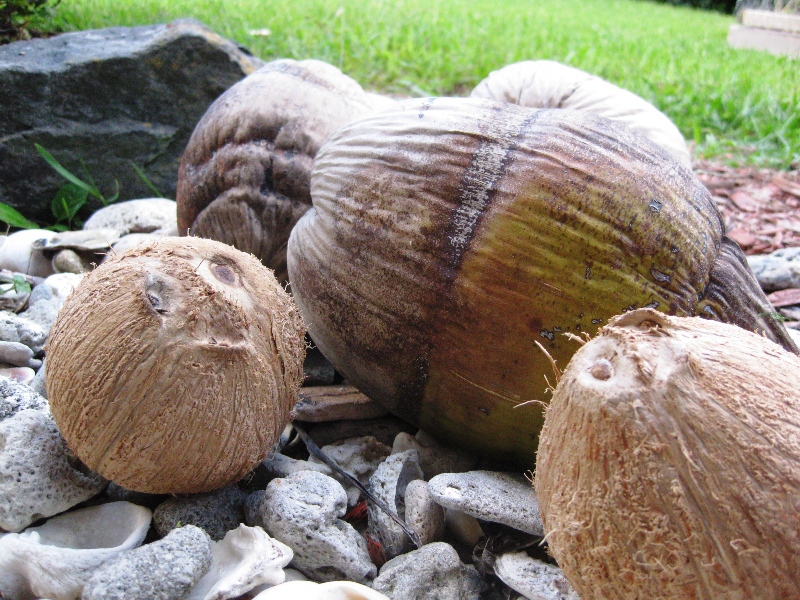
My neighbors have a coconut palm and let us have some coconuts. It turns out that cartoons and Chicka Chicka Boom Boom (link) got it wrong: coconuts don't grow as exposed, three-eyed, hairy creations. Instead, they're covered in a thick protective husk (makes sense if they are to survive a fall from way up at the top of the tree).

Wanting to find an effective way to remove the husk, I turned to Google. Now, I'm no Google novice, but I couldn't find a useful site to help me; I felt like a caveman! After complaining on facebook, I decided to record the steps I take in hopes that they're helpful to some other cavemen (or cavewomen) out there. Enjoy:

How to Remove Coconut Husk

Coconuts grow in a protective husk which helps them to not crack when they fall. This picture shows three larger coconuts in their husk and two more familiar coconuts without husks.


Coconuts in husk (rear) and out of husk (front)

  1. Identify Heavy End and Get Claw Hammer
    One end should be more heavy and dense around the coconut; this side is shown at left in this picture

    The coconut tips because one side is heavier
  2. Use Hammer to Pulverize Light End of Coconut
    Don't worry too much about the coconut inside; it survived the fall from the tree—is should survive this step

    Pound the end to soften the husk
  3. Use Claw End of Hammer to Make Trenches
    These lines of trenches will help in tearing off the husk in later steps

    Score the husk with claw end of hammer
  4. Tear Off a Strip of Husk
    Start at the lighter end, grab a thin strip of husk, and PULL!

    Tear off strip of husk to reveal hard coconut buried inside
  5. Tear Off More Strips of Husk
    Make your way around the coconut, one thin strip of husk at a time

    Tear more strips off around coconut
  6. Remove Coconut from Husk
    With all the husk removed, the recognizable coconut is revealed

    Here's the coconut you're familiar with
  7. Prepare to Drain Coconut
    I use a drill with a 1/4" bit (drills are fun, but a Phillips screwdriver works just as well) to make holes
    Get a container to preserve coconut water, if you like, or suck out the water with a straw (if you like the taste)

    Gather tools to drain coconut
  8. Make Two Holes in Coconut
    Two of the three circles are usually smaller and closer together; these are the "eyes." The third is the "mouth." Drill two holes, one in the mouth (easy because it's larger and softer) and one in an eye (a little harder; it's smaller and harder)

    Drill holes in mouth and one eye (of the coconut, of course)
  9. Drain Coconut Water
    My little helper simply tipped the coconut and the water drained into the measuring cup

    Capture coconut water in container
  10. Inspect Water for Cloudiness
    Clear water indicates the coconut is good, cloudy water equals a bad coconut (throw the water and coconut away if the water is cloudy). If the water is clear, reserve it for later use if you would like.

    Clear water means the coconut is good
  11. Remember to Have Fun
    Harvesting and preparing coconut flesh is a time-consuming process, so take a break and have a smile

    Get the last few drops of water

    Juggle if you have three or more coconuts
  12. Harvest Coconut Flesh
    I tried cooking the coconuts at 350° for about 20 minutes to help separate the flesh from the hard shell. It might crack the coconuts, but they're going to be cracked at some point anyway. (Note: there are hundreds of sites giving advice on how to open coconuts and harvest the flesh. I wanted to have at least one record of how to get the coconut out of the husk, so I'm skimming the rest of the steps)

    Coconuts in oven to (350°, 20 min) to help separate flesh from shell

    Cracked after cooking
  13. Prepare Coconut Flesh
    Once you get the flesh out of the hard shell, you'll see there's a softer shell outside of the white flesh. A vegetable peeler helps remove this tougher skin (it's fine to eat, but pure white coconut is so much more appetizing).

    Remove skin with vegetable peeler
  14. Process/Blend Coconut Flesh
    Place coconut flesh and coconut water in a blender or food processor. Process until smooth.

    Process coconut flesh and coconut water

    Blend/process until smooth
  15. Soak and Strain
    You may want to add a tablespoon of sugar to the mixture (for three coconuts) and let it soak for about 30 minutes. Strain the coconut flesh from the liquid (which is now defined as coconut milk).

    Strain the coconut milk from coconut flesh
  16. Spread and Dehydrate
    One option is to spread the flesh on a cookie sheet and bake at 250°until it is as dry as you prefer it. (I turn the flesh every 10-15 minutes while it's in the oven.)

    Coconut ready for dehydrating
  17. Enjoy!
    Homemade coconut!

    Even better than store-bought

Extra:

Here are the finished products in the light of day (I finished the process after the sun had set):


And here's what we enjoyed for breakfast: Starfruit-strawberry-coconut smoothies!


I think we'll have coconut curry for dinner tonight...