Saturday, February 27, 2010

Two Principles for Any Economy

This entry is part of my general conference application series.

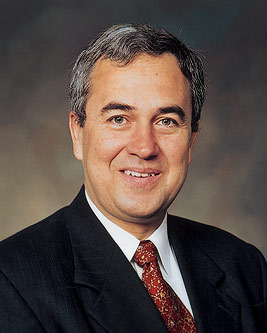
Two Principles for Any Economy, by President Dieter F. Uchtdorf
Second Counselor in the First Presidency


Change. Do you like change?

Change is interesting. On the one hand, you will miss the way things were; on the other hand, the uncertainty of the future is exciting in a tingly sort of way.

We have a new bishop! Change in the church seems more natural than change in other aspects of life. There is the almost immediate reassurance that things are as they are supposed to be. In addition to the quiet feelings of peace are the many experiences I've shared with our new bishop.

Nevertheless, I'll miss the little things: the big bear hugs, the laughing while conducting meetings when a mistake is made, the way our children looked with wide-eyes and a smile as they watched the bishop do anything. (I'm sure the new bishop will quickly slip into a special place in all of our hearts.)

In the hallway, minutes after the meeting was over, I overheard our newly-released bishop sharing his excitement for future service in the church: he was submitting mission papers for himself and his wife. There was not even a moment's break—no hiatus, no rest, not even an apparent deep breath!

The memory of this dedication and strength of heart came rushing back as I reviewed President Uchtdorf's comments on work: "retirement is not part of the Lord's plan of happiness." In fact, our bishop used to frequently tell people (our family included) that because he was retired, they could call on him, anytime, anywhere, and he would drop whatever he was doing to help. While retired, he made sure he wasn't retiring.

He was also known to say, "I'm retired: I was tired before, and I'll be tired again!"

Regarding service and love, our bishop showed a living example of President Uchtdorf's words:

While the phrase “been there, done that” may work as an excuse to avoid skateboarding, decline the invitation for a motorbike ride, or bypass the spicy curry at the buffet, it is not an acceptable excuse for avoiding covenant responsibilities to consecrate our time, talents, and resources in the work of the kingdom of God.

(Our bishop did, in fact, used to ride a motorcycle—but he doesn't anymore.)

Thank you, Bishop Jamison, for your example and love.


I want to be like Bishop Jamison when I grow up!

Friday, February 26, 2010

I Love Loud Boys

This entry is part of my general conference application series.

I Love Loud Boys, by Elder Yoon Hwan Choi
Of the Seventy


I substitute-taught a group of loud and rowdy six- and seven-year-old boys and girls last Sunday. In trying to help the loudest two, I employed two strategies: force, and love.

Force
When the two children wouldn't stop talking (and touching) each other in a meeting, I split them up by sitting between them. This worked for all of five seconds. I then moved one down a few seats, rearranging the entire class. (To her credit, the one I asked to move did not complain about the change at all.) Despite this, the one remaining child turned his distraction on me, poking, talking, squirming, etc. What to do?

The last time I substitute-taught, I saw another substitute-teacher scold and whisper-yell at rowdy children (with less-than-ideal results). I had also seen other teachers completely ignore their class members, which didn't work well either.

I had a decision to make. Criticize or ignore. Or, I could try love.

Love
Placing my arm around his shoulders, I reminded him that I was there. When he would act out or squirm, I would use softly-spoken questions to bring him back to the meeting. Interestingly, it worked!

After a few moments, he was calm and even leaning against my arm.

Elder Choi relates a more labor- and time-intensive account of how he and his family were able to positively influence a dozen such "loud boys." He tells of how he prayed and acted with love to teach these troublemakers a better, gentler way. This was all done with patience, persuasion, and praise.

It's one thing to have twenty minutes of success in a children's meeting, it's another entirely to offer consistent examples and reinforcement.

I want to use more love and less force in my life, particularly with my own children. Elder Choi spoke of the young men collectively, but it is equally applicable to our own children:

Dear brethren, let us love our boys—although some of them are loud boys. Let us teach them to change their lives. . . . These young men are all of our sons. As we reach out to them, lift them, and help them, we will feel like John, who said, “I have no greater joy than to hear that my children walk in truth.” (See 3 John 1:4)


Wednesday, February 24, 2010

Becoming More Powerful Priesthood Holders

This entry is part of my general conference application series.

Becoming More Powerful Priesthood Holders, by Elder Walter F. González
Of the Presidency of the Seventy


Elder González listed one of the benefits of following the righteous examples of those in the Book of Mormon as becoming "more powerful in rescuing others." The doctrine of the Rescue is something that has been discussed much in recent months in our stake.

Stake leaders emphasize that there are four groups of people that need to be rescued (1) those among us, (2) those spiritually disconnected, (3) those seeking the full truth, and (4) those waiting on the other side.

Efforts of Christian missionaries in Haiti, exercising some form of [ill-conceived] rescue, have received a bit of media attention lately. These ten people from Idaho seem to have used misrepresentation to abscond with thirty-three children in hopes of taking them to a yet-to-be-built orphanage in the Dominican Republic. (Please note that this is based on what I've heard from various news reports, and may not be an accurate depiction of reality.)

In discussing missionary work with people of other faiths, I've occasionally heard things similar to: "My parents are on a mission in China [or some other 'closed' country]. They are 'technically' there to teach English, but that's just what their church said so they could get in. It's fine to break a few laws in order to save a few souls."

The kind of rescue that Elder González refers to (and our stake leadership), on the other hand, is more spiritually—and legally—based. I loved how Elder González reminded of how the Book of Mormon recounts when Christ visited the ancient Americas, both teaching His truths and issuing life-saving, and life-changing ordinances. He then said, "in other words, the doctrine and the ordinances stood side by side."

Where would we be with only one of these? Without ordinances, doctrine (or teaching) is meaningless. Similarly, without the truth (doctrine), ordinances are without power or validity. The Book of Mormon reminds that these must always be side-by-side.

In our efforts to reach out and rescue others (and ourselves), it's important that we do as the Lord would have us do, according to established laws (both temporal and divine). I'm grateful for the power of doctrine and ordinances, side-by-side.

Tuesday, February 23, 2010

Fathers and Sons: A Remarkable Relationship

This entry is part of my general conference application series.

Fathers and Sons: A Remarkable Relationship, by Elder M. Russell Ballard
Of the Quorum of the Twelve Apostles


I love to spend time with my family, and it's often hard to leave them for various meetings and appointments. Nevertheless, my children have discovered that if a meeting isn't too late, I'll let one of them come with me and we enjoy great one-on-one time together.

In fact, every general conference, David, my six-year-old, comes to the Priesthood Session with me. He wears his little suit and tie, and sits right next to me the whole time. Many of the other men make comments such as, "training him early, are you?", but they don't know the half of it—he wants to come!

So, there we were, sitting side-by-side when Elder Ballard started the session off talking about the relationship between fathers and sons. Right away I knew that I would love the talk, primarily because I was practicing what it preached!

I listened intently to the many points that were mentioned, not knowing how much attention David was paying to the words. On Elder Ballard's list of three suggestions for the sons, he started with:

First, trust your father. He is not perfect, but he loves you and would never do anything he didn’t think was in your best interest.

Upon hearing this, David turned to me and lovingly said, "Daddy, you're perfect."

This gave me both a big smile and confidence that we were well on our way to having a life-long remarkable relationship:

There is no other relationship quite like that which can and should exist between a boy and his dad. It can be one of the most nurturing, joyful relationships in life, one that can have a profound impact on who boys become and also on who dads become.

I love our Daddy-David time, and look forward to additional father-son time in the future with my other son(s) as well. [I love my daddy-daughter time, too!]


Monday, February 22, 2010

Embrace Life

Do you wear your seat belt?

Even on short trips?

I came upon the following advertisement from the UK, and it really touched something in me. It wasn't overly graphic or full of scare tactics (as many are), but was completely wonderful.


Please watch the video before considering the following:
Did you find this video touching? (I actually had a few tears come to my eyes—even after multiple views!)

What made it compelling?

What did the wife and daughter represent?

Was the man wearing a seat belt before his family wrapped him, or did the belt, in the moment of peril, come to represent what he wanted to live for?

If you were a person who didn't usually buckle up (I'm assuming you usually do), would this ad help change your mind?